Indonesia’s culinary heritage is globally celebrated, and satay stands among its most recognized gastronomic icons. Yet in Bali, the story of sate extends far beyond the dining experience. Within the island’s Hindu ceremonial tradition, certain forms of satay take on a sacred role that reflects a deeper philosophy of balance and spiritual order. One of the most intricate examples is Sate Renteng, a ceremonial arrangement prepared not for consumption but as part of major temple offerings. For visitors and global partners seeking deeper cultural understanding, it offers a compelling window into how Bali’s living traditions continue to shape everyday life.
Sate Renteng appears primarily in higher-order Balinese Hindu ceremonies, particularly during major temple anniversaries (piodalan) at Pura Dalem, as well as within large-scale Dewa Yadnya and certain Bhuta Yadnya rituals. Its presence typically signals a ceremony of meaningful scale, where offerings are prepared with heightened symbolic precision.
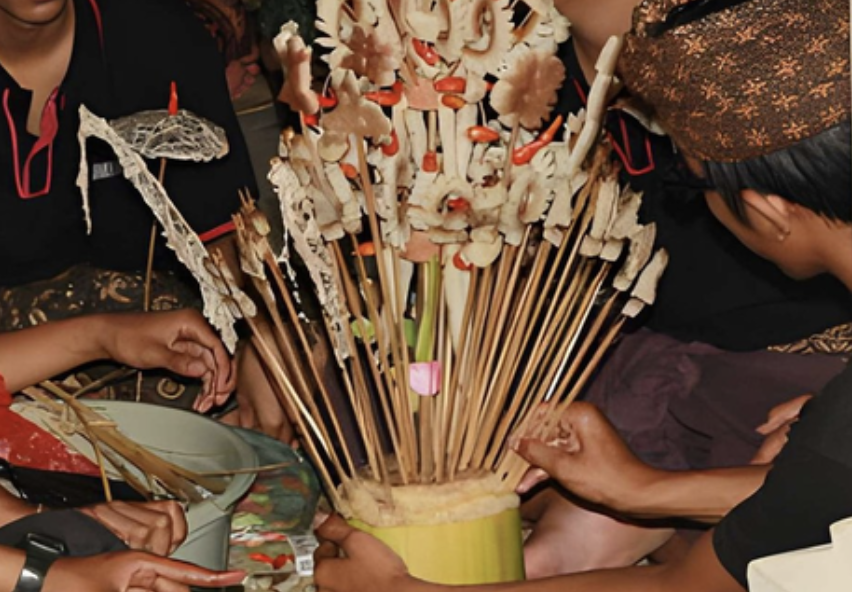
Constructed from carefully prepared pork satay and supporting elements, the structure is arranged vertically-often using banana trunk or bamboo as its base-forming a layered composition that reflects the ordered structure of the universe in Balinese cosmology. Importantly, unlike culinary satay, Sate Renteng is not intended for consumption. It functions as part of sarana upakara, the ritual instruments through which harmony and protection are symbolically invoked.
At its philosophical core, Sate Renteng expresses the Balinese Hindu principle of maintaining balance between the human realm, the natural world, and the divine-an understanding closely aligned with the concept of Tri Hita Karana. Island-wide observances such as Nyepi further reinforce this cultural coherence, demonstrating how ritual life in Bali operates not as performance but as a living societal rhythm.
The tradition remains particularly strong in regencies such as Gianyar, Bangli, Karangasem, and Klungkung, where ceremonial craftsmanship and communal ngayah participation continue to be actively practiced. For experienced global buyers and culturally curious visitors, this continuity signals something increasingly rare in modern destinations: a cultural system that remains authentically lived rather than staged.
When interpreted with care, Sate Renteng becomes more than a ceremonial object. It illustrates how, in Bali, gastronomy, spirituality, and community life remain profoundly interconnected-one of the island’s most distinctive and enduring cultural strengths.
As Indonesia advances its gastronomy narrative globally, BBTF encourages stakeholders to deepen cultural interpretation alongside culinary promotion. With thoughtful storytelling and respect for sacred context, Bali’s living traditions can continue enriching visitor understanding for generations to come.