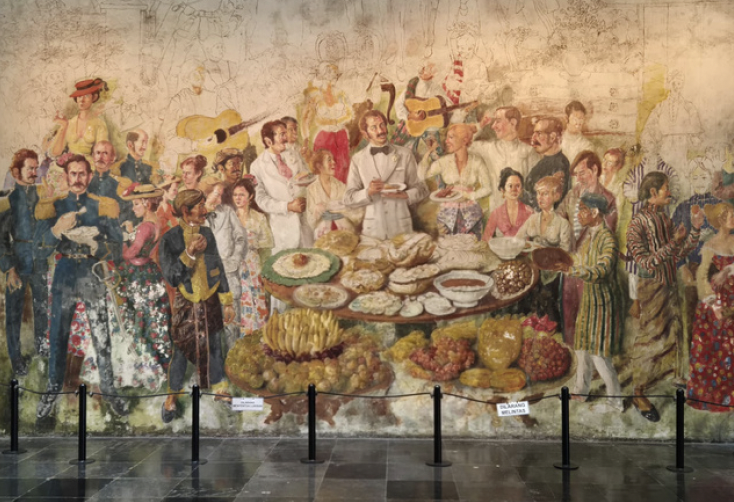
In Jakarta’s Old Town, inside Museum Sejarah Jakarta – better known as Museum Fatahillah – there is a mural that feels like a paused conversation with history. It shows a grand rijsttafel scene: a long table, abundant dishes, Dutch colonial diners, and Indonesian attendants moving through the room. Yet part of the mural remains unfinished, with visible sketch lines still left on the wall. That incompleteness is what makes it so memorable. For BBTF 2026, this story is a reminder that Jakarta is not only Indonesia’s capital, but also a place where gastronomy, memory, colonial history, and cultural exchange have long intersected.
The mural is associated with Indonesian painter Harijadi Sumodidjojo, a realist artist known for observing daily life with emotional depth. Painted in the 1970s under Governor Ali Sadikin, it fills what many visitors now call the museum’s mural room and portrays Batavia between the late 19th and early 20th century – a port city shaped by migration, commerce, hierarchy, and exchange. Some sources note the mural was created in 1975 and spans roughly 200 square meters, making it one of the museum’s most striking visual narratives.
At the centre of the composition is rijsttafel, a colonial-era dining tradition in which numerous dishes from across the Indonesian archipelago were served in succession on one elaborate table. Though often romanticised for its theatrical abundance, rijsttafel also reflected hierarchy: Indonesian food was presented within a Dutch colonial social setting, turning local flavours into a symbol of status, spectacle, and control. At the same time, it revealed something important about the archipelago – long before modern food tourism, the cuisines of the archipelago were already diverse, regional, and sophisticated enough to fill an entire table with identity.
What makes the mural unforgettable is that it was never fully completed. Upper sections remain in outline, with reports pointing to the building’s damp walls as one reason the paint could not properly adhere. That unfinished quality now feels symbolic. Jakarta, too, is a city still being interpreted – part heritage capital, part creative metropolis, part culinary crossroads.
For buyers, the story does not stop at the mural. Kota Tua offers heritage walks across Fatahillah Square, nearby museums, historic architecture, and dining experiences that connect old Batavia to modern Jakarta. It is a district where gastronomy, culture, and urban lifestyle can still be explored in one journey.
“Jakarta’s table has always been larger than the meal itself.” BBTF 2026 invites buyers to rediscover the capital’s layered culinary story through meaningful journeys with ASITA Bali Region.